
The repeated rumble never identified
only a few blocks away.
The birds whose names
never came to me in time.
The years that went missing,
presumably burrowing.
The standing in the ocean
at eight, being murdered by waves.
This is the giddy feeling of things
that are not mine, that were,
that were, that were.
Some Brief Poems
You swim under my blood
like my parents saying my name
in earshot, before
I was born.
— — — — — — — — — — — — — — –
Dementia
Her living cats
wear masks of dead cats
to fool her.
Every day is Halloween.
______________________________
We are riddled with dumb holidays.
But not one “Open a Cage for Something Day”
anywhere in this stupid world.
________________________________________
The butterfly’s amazing book
opens. My eyes go left
then right. I’m baffled.
Which page is the original,
and which the translation?
____________________________________
Yes, that is me
who puts the COMPLAINTS boxes
besides old weathered tombstones
in a cemetery near you
__________________________________________
The mailman stopped feeding
the street’s empty house.
Nights, I sneak over there.
Crouching on the porch,
I slip junk mail through the mouth
of its front door.
_______________________________
IT
depends who you ask.
I ask the darkness.
____________________________________
October
O clobber
the lover
who is anon
and not a moon
__________________________
the marrow
of objectified bones
drinks the rain
______________________________
Lying Down
I lie
in darkness
and lie
to darkness
that lies
escorts me
to me
constantly
_______________________________
listen to the rain
burying something
the soft way
a child does
— — — — — — — — — — — — — — — — — — —
A fieldprick of sparrows
deposits the bush of your life
close as corpuscles in the blood
of someone sitting quiet and dark
thinking one
and disappearing.
_______________________________________
Moon Sleight
All the light
I give you
is just a trick.
I plagiarize
the sun and never pay
a penny.
___________________________
The Ex’s Story
sue
a
side
blonde
__________________________
art form
art farm
antfarm
_____________________________________________
The size of the universe
when I was asleep
just now, impossibly
a child, mother winding thread
around her hands.
*
He lies in bed
with his eyes closed,
clouds.
*
My fingerprints
on a milky windowpane
trapped between two others
For years, the sunlight
comes through me
a crime scene
*
Where the galaxy ends,
my cat asleep
*
Moonlight
is secondhand sunlight.
Some poor souls
are forced to wear this
too many years
to recover.
We arrange
a series of stones
in a competition in the park
The beautiful stone wins
— — — — — -
It takes him 3 tries
to swallow a swig of water
She looks away
and finds herself
growing horns in moonlight
_______________
No one ever asks if the snow is on time
— — — — — — — — — — — — –
You tell me you met this girl
in an old graveyard
that lay deep in snow
where she trudged in boots,
cleaning the ears
of statues with Q-tips.
________________________
Four Poems
2:29 a.m.
Late night, under rain
the corner lights bleed
thoughts into blackness of streets
you walk. Trees silhouette
against silhouettes, just
ready to come back from
the dead. February night.
A train makes its own small
thunder somewhere over by
the river. An old tank of a mailbox
nobody uses anymore holds
the key. A kid’s mitten laid atop
says look I am waiting.
Gingko leaves
Ginkgo leaves since autumn
Have spoiled beautifully underfoot.
We stop and look at the colors.
The yellows and golds of fall:
I remember that weird fog
of radiance they had around them,
the young bodies of leaves.
But this afterlife is better.
rainy Sunday afternoons
On rainy Sunday afternoons
it’s looking at mummies in museums
or thinking about first loves.
On rainy Sunday afternoons,
things spoil into that ripeness
they were meant to have.
the things old people say to you
The things old people say to you
on buses, total strangers. The sum
of a life speaks. Things
like this. Water leaves little
aftertaste. These things
are not water.
The Man with the Bomb in His Head
He sits quietly at work,
seemingly minding his own business
in a cubicle covered with neutral-grey fabric.
He may kill dozens of people this week
or he may take his family to Disneyworld.
He may finally ask forgiveness
of a priest or family demon or a character
in a book he is reading. His only friend.
He may apologize to random strangers on the street,
wishing they existed in a different way,
more substantial than the phantoms
they have become in his blood fantasies.
He may change his mind and join a cult,
a yoga studio, a paramilitary organization,
the Green Party, a swinger’s club or PETA.
He may just join all of these at once.
He may seem increasingly attentive to his wife
or significant other, like the mother who took
her young son on an amusement park spree
before disappearing him forever.
He may become more charming at work,
explore various gambits, make sexual overtures
with the bomb ticking in his head. His favorite color
may change. He may listen to that music
he always hated. When he stands on the stairs
that lead into work, watch how he flickers
like an image on a bad television.
Someone may hear his body ticking
and wonder where it’s coming from,
that weird sound. One of his kids might spend the night
at a friend’s house and refuse to go home
the next day, without being able to explain.
This kid will think about his sister later,
for the rest of his life. She didn’t spend
the night somewhere else. The man
with the bomb ticking in his head sits quietly
at work and smiles when he looks up
from that book that is making him so happy.
The book titled Butterflies and Their Ways.
I Can See the Furniture

People are making furniture
merely by sitting on rocks.
The first furniture, moon-like,
is pocked and cratered
like the years themselves.
Then the people are busy shaping
bits of trees into legs and backs.
Let us sit stiffly as our minds.
We’ll stare at each other
from various thrones
and see what happens.
Some people fall in love with curves,
and ask, can we have them soft, and yes.
The furniture of clouds arrives.
We soon exhaust the line itself.
We crave novel materials, intelligence
in the thing that holds us
more than our lover does,
more than we hold our children.
One day, looking at furniture,
we realize, glumly, how little has changed.
If we are honest with ourselves.
You watch a war happen in a phone
in the palm of your perfect hand
while waiting for dinner.
Some autumn thought keeps eluding you.
You look out the window at the thing
the trees are doing with the leaves.
Is it pretty to be trapped in seasons
beyond your control? They repeat.
You repeat. The meal is ready,
and it’s your favorite. For a moment,
you forget what that is. Then you see it
arrive from the future, like the past.
Red Moon Anthology
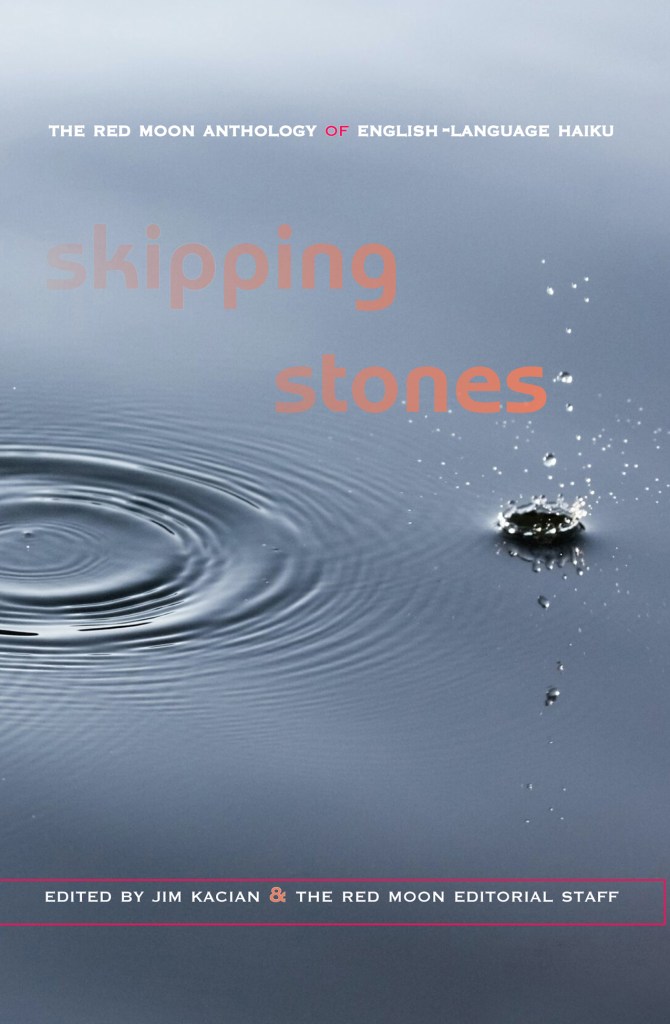
Jim Kacian publishes so many readworthy books. Probably few people outside the ELH (English language haiku) circuits of publishing realize some of the most interesting experimental writing these days is being done in haiku and related shorter forms. Some of my favorite magazines fall under that (concentrically expanding) genre. Kacian’s Red Moon press has published some of the wildest, genre-bending lit in the past few decades.
I have so many Red Moon books in this house. I have too many favorite authors, truly, but just off the top of my head I would highly recommend anything by Dietmar Taucher, Elmedin Kadric and Scott Metz.
I’m happy to be included in the 2022 review anthology which was just published this past month. You can visit Red Moon for yourself and check out the rather weighty back catalog of available titles.
The press sums it up: “The Red Moon Anthology of English-Language Haiku each year assembles the finest haiku and related forms published around the world into a single book.”
Jim Kacian’s writings are something to which I enjoy returning, from his early books like Presents of Mind to his more experimental work the past few decades.
I feel it’s unfortunate that most people outside these haiku circles fail to realize how much it has become a self-hybridizing and wild and natural and absorptive thing. If you dip in this pool, you may never leave.
I also love that small format for haiku books, just about the size of a slice of bread. I love holding in my hands a very small book with a very large consciousness.
Foundling
Darene heard a mewling in the cold night and figured it was a cat at her door begging for scraps. But when she opened the door a crack, it was a swaddled babe in a basket left there for her.
She took it in. For these were hard times and it was one’s duty. The babe was a girl and within a few days Darene named her Tressa. She felt fortunate in being able to nurse the babe, who had a hearty appetite. And she felt fortunate to have a cradle at the ready. The motherless young woman had within less than the changing of the moon lost her only child to a fever that was suddenly everywhere.
Tressa grew at an incredible pace. She was twice her size in a day and by the next day the child walked. Then she began talking on the next day, voluminously and with early wit. Darene knew at that point the child was bewitched by the fairies…or a fairy herself, a changeling.
The country woman knew not to let the other villagers discover the child. Her young husband, Senan, kept their secret well. For the bond had already been made in both their hearts. Surely the loss of their own made them lose some of their natural fear of the uncanny child. After sixteen days, she was a young girl on the verge of womanhood. She sang such beautiful songs she could not have learned from mortal voices. Indeed, she had not left the house and what could she hear from a window at night?
When the twenty-fifth day came, the child was almost as old as her new mother. Darene began to cry in private, out of the young woman’s sight, because she saw the writing on the wall. It would not end well unless the spell could be broken.
“Can the spell be broken, child?” she asked her in all candor in a moment of weakness.
“What spell, Mother? I am as I am,” was all she replied.
So the days raced on and before long at all, the child was older than the mother, then grey-haired and wrinkled. Once again, Darene nursed the child, but this time as an old woman who took spooning from a bowl.
“Thank you, Mother. I love you dearly,” the old woman rasped as the spoon fed her the gruel she had loved as a babe.
“My sweet babe, you are approaching ninety. I can read it in your dear wrinkles. What will happen to you? What can your father and I do?”
“There is only one thing can be done. Place me before the door of one who is kind and patient like yourself. Then leave me. Never return to visit me and never touch me again, else I shall die as sure as the sun sets each day.”
Darene knew she must not go against the law of the fairies, so late that very night she carried her “child” to the doorstoop of a woman in the neighboring village. It was one she knew to be patient and kind and childless, since she guessed that part was important too, the keeping of the secret. Siblings can never hold their tongues. But a loving mother and father can.
The old woman put a finger to her lips as her mother placed her on the cold flagstones before the dark small home. She had her wrapped in a blanket, the original one in which she had arrived. There was a basket under her, but she crowded it now with her size, though she was frail and shrunken with age. She smiled up at Darene, a beautiful smile of gratitude, a child’s smile of thanks, though she was bony and vulnerable as a nestling.
Darene turned and ran, and wept as she ran. She did not look back, not even when she heard the wailing of an infant behind her. Nor when she heard the creak of the door opening, by which time she was well-hidden in the shadows of trees that lined the street.
And then she heard the cooing of the young woman, and her loving alarm, and she knew her part was done.
Valentine
It’s to have a snooze over.
Seriously, pink paper Cupid silhouettes
go up in the massage parlor windows?
Somebody walks your dog for you. Somebody
buys you a Starbucks mug. Somebody
pays your rent and then someone
else does too. Woo hoo.
Do. Do. Do.
It’s pink capitalism. Capitalize.
Do you still get butterflies?
Or only caterpillars?
This is late caterpillarism here.
Sorry, I just can’t buy into this paper economy.
Flirt

A house was flirting with another house.
It did everything to get its attention: change its curtains religiously, manicure its lawn to perfection, place atop its head like a tiara a turning copper weathervane that featured nearly-mating deer that squeaked its interest every time the wind blew…
But the other house remained stolid and uninterested. It slumbered most of the time and might have been drunk. It started losing shingles and getting unsightly patches on its lawn.
Still, the ardor of the covetous house was only inflamed further by this loutishness. It took house tours at Christmas to see if jealousy would do the trick. It appeared in the local newspapers where weirdly-hatted people praised its fine preservations and perseverations.
Nothing.
Then one day it began shooting arrows into every window of its would-be beloved. It got a junior member of its retinue (a rather bad child) to do this for it. After that, it at least had the house’s attention. It felt the other house watching it all hours of the day and night.
When moonlight bathed the flirtatious house like night cream, it would wink from a small dormer window at the one it desired.
Soon after, the stalked house sold itself and had itself bulldozed and carted away. It wasn’t a subtle ghosting at all. There was a wrecking ball.
An elementary school was built in its place. With time, the amorous house faded into spinsterhood, hating the sounds of children at play, and cracking its floorboards and stairs like aged knuckles for centuries.
Grilled Cheese Sandwich

Dying people sometimes get queer ideas in their heads. I remember my Mom in hospice talking about Archie. She wanted to talk about him every time I visited. She asked if I remembered her making him grilled cheese sandwiches on so many days, all those years ago. And tomato soup. I nodded. I didn’t really want to talk about Archie.
His mom had been dying all that winter. He used to hang with us, the usual gang of boys and one tough girl from the same few suburban blocks. But when his mom was dying, he stopped hanging out with us. He started visiting our moms when we were outside playing or down in the bowling alley or at Rex’s house down in the basement figuring out how to make homemade gunpowder with things we bought at the corner pharmacy store, one by one, to avoid arousing suspicion from the canny old pharmacist. Archie would use his pity routine to get all the moms to make him a grilled cheese sandwich and tomato soup. He would even ask for ones to take home afterwards in wax paper. So he could heat them up later. Gross. He’d always be gone before you got home. I sort of just blocked it out at the time. You can’t pick a fight with a kid whose mom is dying.
My mom kept talking about Estelle and her cancer. One dying person talking about another person who died long ago. She didn’t even know Estelle all that well. She would just say hello to her at the pool club in summer, two ladies talking about next to nothing under those shadowy floppy hats. She used to have sharp things to say about Archie’s mom before she got so sick. Married women kept their eyes on her. But Archie’s mom had died so young. And she wanted to talk about how Archie would watch Wheel of Fortune with her. He’d sit in my dad’s old recliner and guess the puzzles long before she did. It made her smile. She said she always loved his red hair. She almost married a young man with red hair once, she added. Her tiny laugh was short on air.
She asked if I would do something for Archie.
Archie’s been dead twelve years. He only had his mom and no siblings. Still. “What,” I asked her, in the most sincere way possible, I thought, “could I do for Archie? Tell me, Mom. “
“Oh, I don’t know. It just seems you could do something for poor Archie.”
I didn’t ask her if she wanted me to put a grilled cheese sandwich on his grave. Although something dark and wicked inside me had smiled into that thought.
“He didn’t have any brothers or sisters, did he? No one. Maybe a pet dog. He had a dog, right?”
The morphine was taking its toll. Her voice had become so much frailer, barely breaking her whisper. I held her hand and it was almost inert. It forgot to shape itself to my hand. But it remembered after a while.
“Yeah.” I had to pull back the scrim of time. It took a moment. “Baxter. His dog’s name was Baxter.” Scruffy thing that was always getting loose and eating people’s trash. I felt a twinge of pathos for no reason. That the dog’s ghost was suddenly dragged back here, I guess. I could see Archie angrily walking him home, hand hooked under its collar. I heard its whimpering.
She was silent a while with her eyes closed, inwardly following the river.
“Baxter.” She smiled at the name. It gave her such deep pleasure. “He must have loved that dog. I bet the other grilled cheese sandwiches were for that dog.”
“Maybe.”
I remembered how Archie had changed not much longer after that. We had seen him getting in cars with older men. We knew he liked the sorts of drugs no one was interested in scoring from him or sharing. We grew apart fast. I’d still see his red hair across a room at a party occasionally, but less and less. These are things I couldn’t tell my mom. She had a cute little orphan waif in her mind. She was tending to him.
“I never told you this but I thought about adopting him. Archie. After his mom died. He could have been your brother. How different things would have been, eh?”
Her eyes brightened a moment and she turned and looked into me, to see everything I was or might be, before falling back into Morphine River. The look only a mother could give you.
“How about that?” she said, her eyes still closed.
“That would have certainly been…different.” I wondered if she knew how horrible he had ended, after all. It seemed she might. Or part of her might anyway.
“Do something for Archie,” she said. And she moved her right hand in the air as though she were drawing something. Then she fell back deeply into that thing like sleep. After a while, I stroked her hand and told her I was leaving and she nodded from deep under there. I told her I would be back later that night. She didn’t nod that time.
Driving home, after a while, I weirdly pictured Archie sitting next to me. Right there in the passenger seat, riding shotgun. He started to talk to me and it was just imagination but it started to hurt. Because ghost Archie was kind, not an asshole at all. He was fully adult, a brother, something he never had a chance to be. We had just been visiting our mother and he knew what to say. He knew her well.
When I drove past the river where they found Archie, it was still light but barely. I pulled over a moment to look at the choppy ice covering the river and drifting towards the bay and all the smoky colors in the western sky. All that ice but nothing solid and no crossing. The little islands in the river already treasured their darkness. I sat there and wished I was a painter like a fool. I wished I was a foolish painter who believed in things like this, totally believed. At least for a minute or so. It was a sort of scorch on the soul. The inability to translate what I thought I saw in hunks of ice drifting and the new dark of the little islands with their trees. I took a photo with my phone and it was ugly as fuck. Nothing like what was there. I threw it down on the passenger seat in disgust. Then I just drove home.
 FICTIONESE