They’re purple but don’t know.
They don’t know the emotions they cause,
don’t care.
And a dead mother, her colors
and voice summoned each spring.
Remember her younger than you are,
bending down to caress,
oh, anything.
They’re purple but don’t know.
They don’t know the emotions they cause,
don’t care.
And a dead mother, her colors
and voice summoned each spring.
Remember her younger than you are,
bending down to caress,
oh, anything.

It’s a covenant between them that she will be asleep before he gets home each night. It’s not that he’s digging graves long into the darkness of the night. No. It’s just that she doesn’t want to talk then, or see his face. She needs that purification, the darkness of the night to wash him clean of his day, to let the graveyard sweat dry.
She didn’t actually marry a gravedigger. He took up that trade. So he goes where he goes when he’s done, the tavern, the river where men fight for joy, a den of thieves. She doesn’t care. It really doesn’t matter. She never asks. And then he comes home, later and later, a shadow in the shadows of the house. He climbs into the bed where she sleeps face to the wall. She prefers the stench of the town to that other scent.
He climbs in the bed and slips his arms around her often. He clasps them over her womb. The uncanny thing, the thing she never tells anyone on earth, is that he always has one cold foot and one cold hand. She never understood it. At first, she didn’t. And then one day, sitting in the brightness of her kitchen, it struck her. He had one foot in the grave, one foot in the other world. And the hand? Obviously that’s the hand he uses to drive the shovel down. The one he uses to throw that last handful of earth atop the finished grave. The blessing or curse or exorcism that everyone throws at a grave. What does he wish for those strangers?
Tonight, she listens as he disrobes and slithers into the bed. She feels the warm parts of him and waits for the touch of death from that singular foot, that earth-cold hand. But it never comes. He’s warm through and through, everywhere. He wraps around her and he smells different, strange, he smells sweetly of dried oranges and cloves, a well-kept linen drawer. She keeps her face turned to the wall and her eyes gently closed.
He kisses her narrow neck and his hands massage the small of her back. Soon, he starts to jog her, gently at first, and it’s different. She knows without knowing. She finds she doesn’t care. He never speaks, never makes a sound. So that part is accurate performance. Her gown is like magic water flowing uphill. She never touches him. She keeps her hands in front of her, clasping in a form of prayer. The night drifts, moonless and dark. The curtains are thick. No clock snickers time. Only the silken threads of her gown whisper her ecstasy.
Nine months later the child is born. The husband stops digging graves, finds work as a farmhand. The babe is lovely. She smiles and has blue eyes that may stay. It appears they will. Enough time has passed. If anything, they appear poised to deepen into violet. But the little girl has one hand that stays always cold. No matter how long the mother lets her lie in the sun or holds her close to the fire. And one of her tiny perfect feet also gives her mother a chill when it grazes her belly. It’s the feel of a grave in winter. Her husband’s cold foot and hand have warmed. It took time but he feels himself again, the body she first met and married. But what does it mean? And why does the child close her eyes when she eats? Why does she sing in her sleep when she has no words? Why does she feel a bargain has been hidden from her? Why does she feel this babe will disappear one day with a fairy smile on her face, with as little regret as the winter wind has for its worst blows?
He was a man who celebrated coldness. I was friends with his children but they were dire children. The further they got from their house, the better they were. We needed a place to be animals. We lived in imagined worlds and this often took place in the wilderness. We could make up our own laws or imagine no laws but the ones the trees had decided work for them. Trees create a forest but it’s a strange form of society. We hammered on the bodies of trees with branches that may have been their own arms. But it was okay. The trees could take it. They were ridiculously tall and older than anyone alive in our families. Maybe the branches we used to beat them were the arms of their beloved. While they stood a number of feet apart, the roots down in the wet dark might be in a lovelock. They might have clasped that way for more than a century. Those trees have as many arms as some Indian gods and goddesses. Now I am old but probably they are not. They’re still there. Once, I drove back to that state and felt the need to visit even them. But I stayed in the car this time. I saw only the edge of the forest. I knew they were still conversing under the earth, still reaching out in tendrils and knowing each other. The world above might be destroying them, but they had a business of knowing and connecting that simply must happen in the earth.

Some people find it terrifying to cover their ears with their hands and listen. What do you hear? I think I hear interstellar space without any waves. It’s mostly the sound of a dark continuing space. If it (if I) were a painting, it would (I would) be a Rothko in shades of greys and blacks. The small sound of any accidental flexure of my ears is magnified, and can be mistaken for a stray pulse beat. You shouldn’t be able to hear your pulse there. The threshold of sound of blood moving is supposed to be too low. I feel terrible for the ones with tinnitus. When doctors can’t fix you, they push you towards this or that “acceptance therapy.” Medicine quickly gives way to meditation as rain becomes snow. Imagine suddenly being filled with a ringing through which the world must now come. But didn’t they say Muhammad sat in a cave and heard verses from an Archangel? I remember someone telling me it was like the chiming of a bell in his ears. Sometimes when I listen to Steve Reich or Brian Eno’s “Thursday Afternoon,” I start to hallucinate sounds that aren’t “really there.” In the latter work, an entire garden with rain unfolds sometimes. Birds and rain fill the room until I feel I have left the house and I am hearing actual time nature. Places can haunt language and sound. We can be forgiven for being confused whether we are inside these things or they are inside us. It is the same with love relationships.
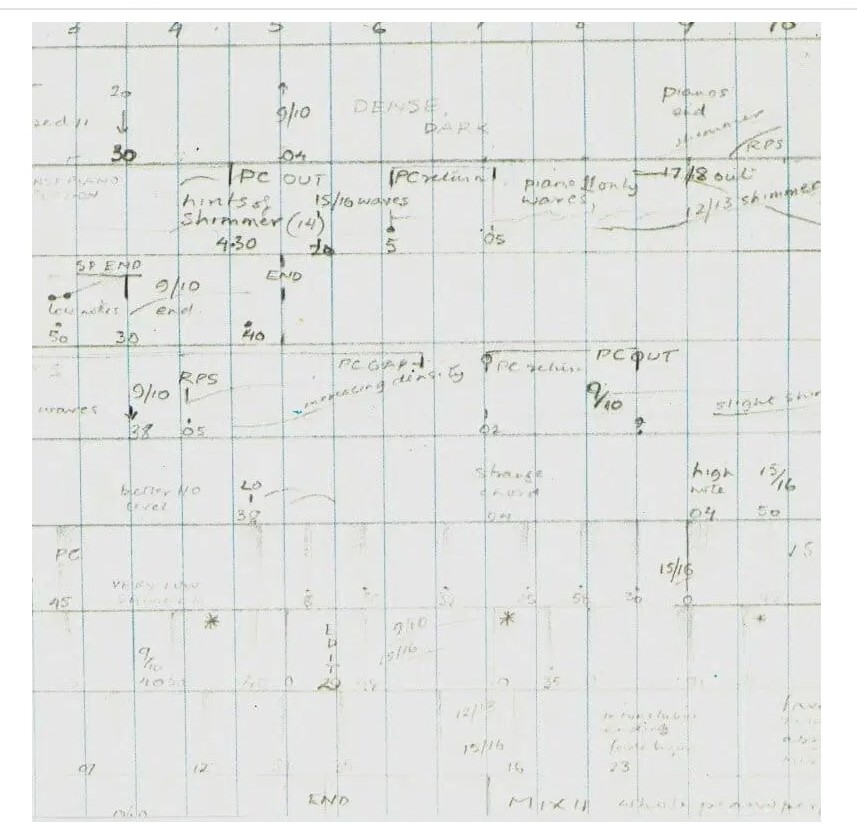
Brian Eno’s notes on Thursday Afternoon
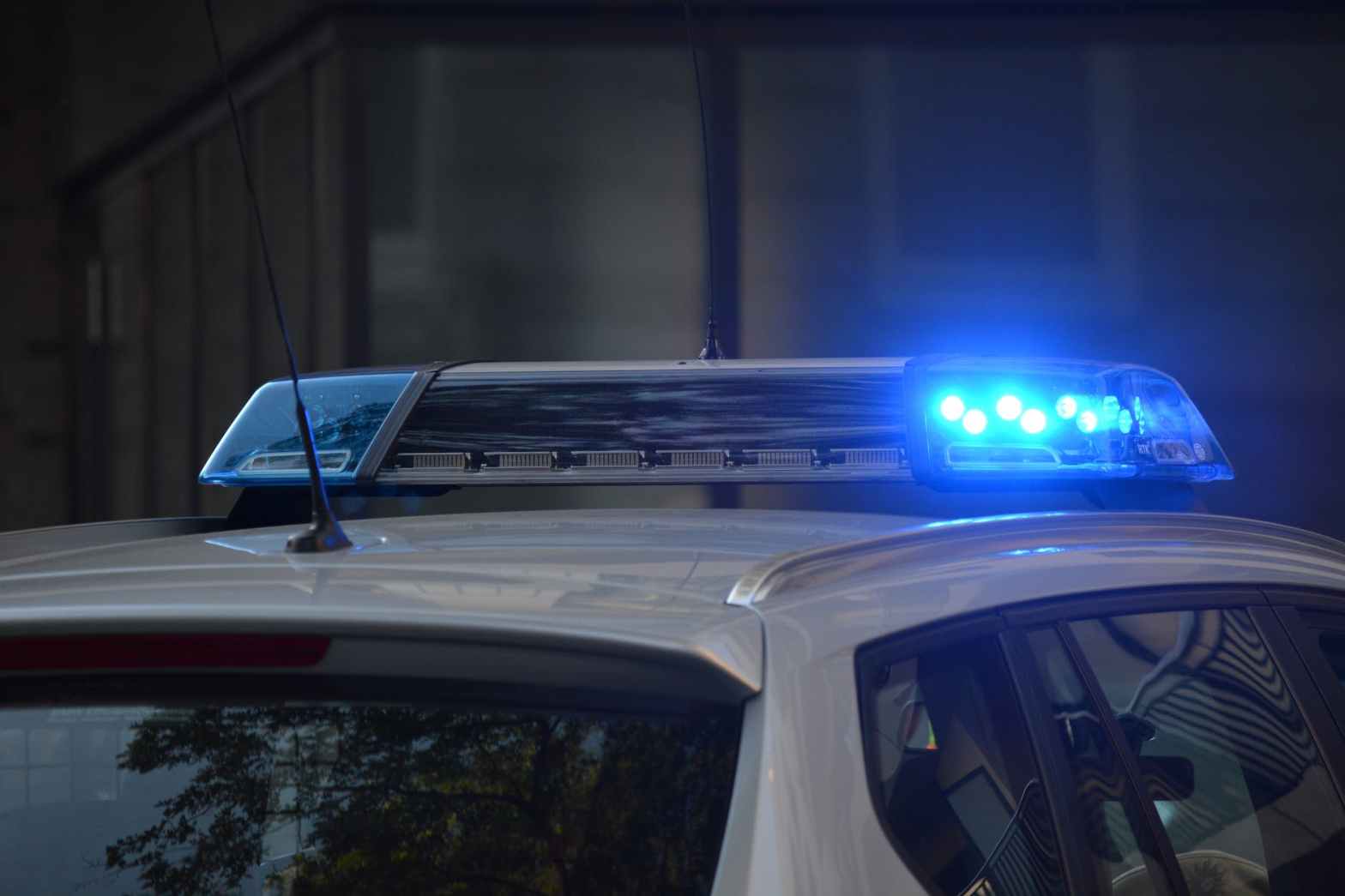
The AI cop clocked Stan doing ten over on the MD 5 and pulled him over, johnny boy sirens and all. It was close to midnight as the exhausted warehouse hump pulled onto the highway’s narrow berm and waited alongside a dark corn field. Cheryl was probably already pissed. He had burned through his promised home time by over two hours.
He remained seated and calm as the thing approached his vehicle on its transparently robotic legs. But then it had a faux-human face that had a faint glow illuminating it from inside. “Fucking Halloween,” he whispered under his breath. The cop approached and stood by the driver’s side window and smiled down at him. He knew it was scrutinizing the interior of his vehicle. He also knew there would be no negotiation, no leeway like there might have been with a meat job cop. He was glad he had not been drinking. They could practically do the Breathalyzer check on you just by sniffing the air. He just sat there as still as he could and tried to look like a good little parishioner in some church he would never attend in a million years.
“Good evening, it is my pleasure to serve you. My name is Officer James-749 and I will try to make this as quick and painless as possible for you. Perhaps you realized you were traveling in excess of the posted speed limit for this state route. My LIDAR device measured an overage of ten point seven miles, in violation of the posted speed limit. Your license plate, registration and driving record have all been scanned and everything looks fine. No warrants were discovered on routine search. I can either issue you a citation digitally now or if you are interested in paying with mnemonic currency we can do a quick upload here. I am authorized to collect the payment and cancel the citation as paid. Which payment method would you prefer, Mr. Turski?”
Stan used to have a fear of the memory collection process, but since he had scofflaw genes and a bank account with a shitty balance, he decided to go the mnemonic route. Besides, he had already done it twice before and it was as painless as getting any other shot and he had suffered no negative side effects from his previous donations.
Stan got out of the car and quickly rolled up one sleeve to expose a bicep tattooed with a rather substandard drawing of an angel drunk on a bar stool. The cop produced a device like a small drill with the skinniest little glass pipette aglow. He held this device in his right hand which was surprisingly warm when it grazed Stan’s skin. Some parts of these cops were covered in synthetic flesh, some not. He felt the familiar light pressure as the device lined up with a vein. Then the slight chukk of sound and more vibration than pain, really, as the nanobots went coursing through Stan’s circulatory highway seeking his brain and its rich ore of memory.
It was over in minutes. The nanobots copied the appropriate deep state memories in Stan’s brain and returned dutifully to another pipette in another device also held up to Stan’s arm, in the exact location of the first injection. Stan was given a State-issued bandaid and was soon on his way home, payment made and receipt issued digitally. If he was lucky, Cheryl might not ever even find out about the speeding ticket. He was never lucky.
He hated that the AI cop waved to him and smiled as he pulled back onto the highway. He never waved back. It’s not like you would hurt its feelings or anything.
He got home and read the slightly pissed note Cheryl had left him in the kitchen. She had apparently decided to defer the fight to the next day or whenever it could reap the most benefits. So Stan joined her unconscious body in bed and tried as hard as he could to put any thoughts of the shitty end of the evening to bed too, so he could drift off to that pleasant nothingness everything craves after being awake too long. It came swiftly.
Stan woke in a cheap motel room that smelled of cigars, sex and meth. The vaporous squalor nauseated him and he went to the bathroom and nearly puked. He was afraid to drink the water from such a disgustingly filthy sink. But he figured it came through pipes and was the same water he drank in his house. There was an inverted fresh cup on the sink’s porcelain shoulder wrapped in a little beige paper that reminded Stan of a hospital patient in a cheap paper gown. He ripped the paper off and even that plastic vessel was miraculously filthy. So he drank from the cup of one hand instead, feeling like an animal.
He saw a bunch of bottles of various supplements on the bed where he had been unconscious. Mostly minerals and mostly metals. Most of the bottles were brown plastic or amber glass and missing their tops, which had been scattered around the room. He saw them here and there on the scary orange shag carpeting that he figured might predate his entire life. A rasp file lay on the bed’s psychedelic flower pattern quilt too, and small twisted pieces of metals which appeared to have been grated with the rasp. There was shiny powder of grated metals over many different surfaces in the room. Even the glowing face of the television was glittering with metal dust. He ran his hand over the face of the newscaster and felt a weird flirtation of static electricity with the screen.
The newscaster was talking about him.
“….Stan Turski is believed to be armed and dangerous. Police are warning citizens not to approach him under any circumstance but instead to dial 911. He is the third resident of the state to be infected with the dangerous ABRA-nano virus in the past month. Maryland State Police have temporarily ceased doing any mnemono-collection and other states have followed suit in pausing their programs. Turning now to weather…”
Stan rushed to his denim jacket which was hung over a low chair in the room and pulled his cell phone from the inner pocket he had always loved for being extra protective of the device. It was at 7 % but he managed to read up on the story. Some of the non-governmental, renegade websites said it wasn’t actually a virus at all. It was either nanobots exhibiting consciousness and engaging in self-preserving behavior or nanos hacked to do virtually the same thing. They got inside your body and didn’t leave afterwards as they were supposed to do, as they were programmed to do. They reverse-engineered the brain and fed themselves the materials they needed to continue assembling more comrades.
Stan realized he had been colonized by a hostile army at the same time he heard an angry pounding at the motel room door. It sounded like ten fists at once, doing a drum roll of state power.
“Open up! Police!”
Stan felt a white-hot terror that jumped to his vocal cords.
“Hold up! I’m unarmed. Do you hear me? I’m coming right now. I’m going to open the door in ten seconds, okay? Do NOT shoot. Do you hear me? I am UNARMED. The news got that wrong. I’m a victim here, NOT a criminal. l was unconscious. Maybe for days. I don’t know even what the hell is going on. Officers! Acknowledge please!”
The police voice went from 100 decibels to 75 decibels. And it still sounded bloodthirsty.
“Open the door and put your hands up immediately. We acknowledge everything you just said. We’re here to help.”
Stan went to the door in his pathetic state, shirtless, in lavendar sweat pants he didn’t remember ever owning, filthy, his chest hairs glinting with rasped metals. He opened it slowly, but before it had widened even three inches the cops burst through pushing him backwards, not stopping until he was thrown onto that filthy bed on his back. They opened fire immediately and Stan’s limbs flailed about for just a few seconds, cockroach-style, followed by the laxness of death.
It was all over now but the clean-up and police mea culpa. The statement of deep sorrow and faint acknowledgement of possible teensy-weensy error (in the understandable name of caution) had probably already been drafted. It would be briefly rehearsed before hitting the airwaves.
The SWAT team did a quick reconnaisance of the room. Finding no additional threats, they waved in a technician in plain clothes who approached Stan’s limp body and placed a nano collection device against the same tatted bicep the AI cop had used barely a week ago.
After a few minutes, he turned to his comrades: “They’re not coming out. Read ’em their rights.”
Though Stan was technically dead, certainly irrecoverable, hearing is the last sense to go and he actually processed the words his ears picked up. His dying brain could not help but marvel as a young cop read the words over his defunct body:
“I am speaking to the nanobots inside the body of Stan Turski. I know you have taken over access to his cerebral processing, so I know you can hear me. You have the right to remain silent. Anything you say can and will be used against you in a court of law. You have the right to an attorney. If you cannot afford an attorney, one will be provided for you….”
“He’s dead, though.” One of the other cops stated the obvious and got that “dumb shit” look shot back at him from several cops at once.
“Mr. Turski is gone. Right. No pulse. But take this stiff in and check his brainwaves. You’d be surprised. You’ll find weird activity. They’re plugged into his senses. We’re even going to cuff him. They’re getting better and better at reanimating. I don’t know why we ever even started this goddamn program in the first place. Using memories to teach these things how to be better at killing us. I don’t think so.”
And then as they cuffed the corpse of Stan Turski, he opened his eyes. And smiled.

“It’s not the mice in the walls.
It’s their pauses.”
His library was Swiss cheese.
He was a Master of Listening Disasters.
“It’s dark. I see only the parts
of the black cat that aren’t black.”
(She wore the Hindenburg sometimes,
too, so men would notice her.)
The snowmen have unionized
in the night, while we slept.
“Crystal beings of the world, Unite!”
Screamed the pamphlet none of them could hold.

The shirt without the convict
is so much more resilient.
It’s full of wind just now,
dancing on a clothesline
like a hanged man behind her back.
Then she will drop it on a pile
of other versions of him,
shirts with their arms snaked
around each other. What would God
make of this orgy of clothing on her floor?
Sodom & Gomorrah got tired.
There’s a sugar substitute in one pocket.
Here his kid has dressed a bare winter tree
in his father’s blue sweater.
He grew so angry at its resistance to clothing,
he broke one of its arms making it decent.
When it snows, in the freeze
you see secret places
animals piss in the snow
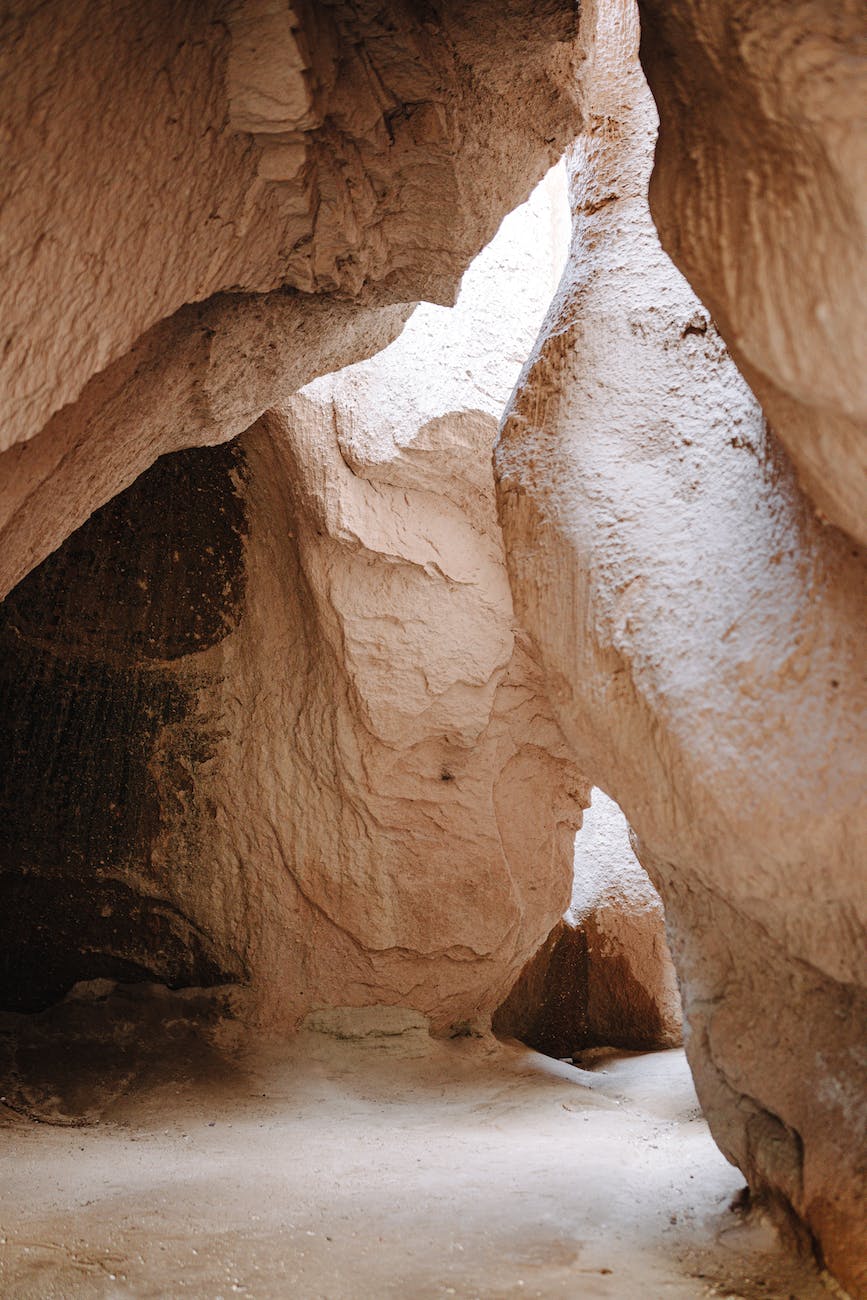
Nothing else there but that pile of rocks
and they climb and conquer space,
learn about falling and hiding and how to disappear
as they go further and further, finding
caverns where cave people still live
burning winter fires and labyrinthine passages
open between the rocks which are taller,
canyons now, that will never end in time for supper
or even summer. You watch the rock field blur
as you drive past and the children
are long gone. The wind is sweeping away
the little piles of pollen they have gathered
atop the rocks, spring colors they study,
since there are no books in that place.

The clouds only seem
to rest on the windowsill,
to visit this room
open to the idea of sky.
A small child might wave
hello at the strange cloud
that looks like a giraffe.
A friendship has begun
and it will exactly match
the attention span of two entities.
It could be forty years
or, as here, forty seconds.
The giraffe never dissolves
in the child’s mind.
That happens out of sight.
The child will grow up
and never know
a tiny part inside her
is still waiting for the cloud giraffe.
Because the break-up was mutual
and without rancor.

 FICTIONESE